Taking steps towards harnessing signals from skin to promote metabolic health

Caroline Alexander
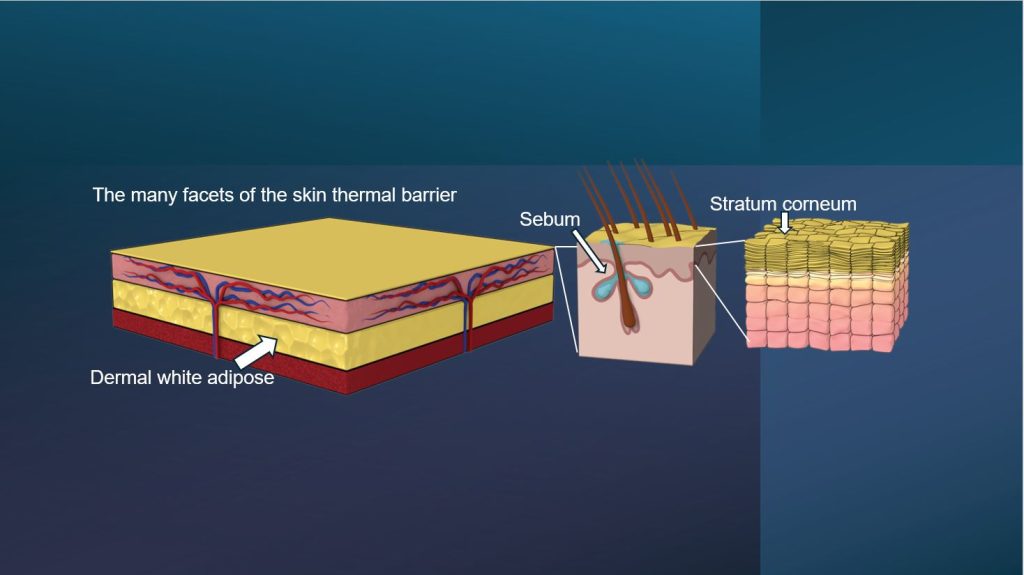 In this paper just published in Nature Communications, Riley et al. show that the thermal properties of skin are highly reactive. Depending upon the exact diet fed to mice, their skin becomes more- or less-heat permeable: When skin becomes more heat permeable, the demand for heat production is increased. When mice are fed a high fat diet, the majority of lipids are delivered to skin— indeed skin turns out to be the largest site for assimilation of dietary fat, where lipids comprise the building blocks of the thermal barrier. Within days the properties of skin are changed to become less heat permeable and, in contrast to other organs, a single fat bolus persists for weeks in skin.
Vice versa, when mice are fed a health-promoting diet—in this case, a diet with low levels of an amino acid, isoleucine—their skin becomes more heat permeable, a preamble to the establishment of a healthy lean weight, regardless of the consumption of a Western diet. Riley et al. found that calorie restriction dramatically depletes skin, which becomes resistant to acquiring the dietary lipids. Although adipose and liver have long been considered to be the organs that coordinate the response to calorie restriction, this study could place skin front and center of the responder tissues.
To search out the molecular basis of altered skin properties, this paper includes state-of-the-art mass spectroscopy of the skin lipidome. The authors’ focus on skin-associated lipids started with observations of genetically altered mice, where the loss of specific lipid species from skin led to systemic metabolic changes, such as resistance to diet-induced obesity. Riley et al. show that altered skin properties align with changes in lipids made by both keratinocytes and sebocytes—these cell types are responsible for the production of the epidermal stratum corneum and the sebum respectively. It will be important to find out whether these cell types collaborate to maintain a balance of skin function.
In this paper just published in Nature Communications, Riley et al. show that the thermal properties of skin are highly reactive. Depending upon the exact diet fed to mice, their skin becomes more- or less-heat permeable: When skin becomes more heat permeable, the demand for heat production is increased. When mice are fed a high fat diet, the majority of lipids are delivered to skin— indeed skin turns out to be the largest site for assimilation of dietary fat, where lipids comprise the building blocks of the thermal barrier. Within days the properties of skin are changed to become less heat permeable and, in contrast to other organs, a single fat bolus persists for weeks in skin.
Vice versa, when mice are fed a health-promoting diet—in this case, a diet with low levels of an amino acid, isoleucine—their skin becomes more heat permeable, a preamble to the establishment of a healthy lean weight, regardless of the consumption of a Western diet. Riley et al. found that calorie restriction dramatically depletes skin, which becomes resistant to acquiring the dietary lipids. Although adipose and liver have long been considered to be the organs that coordinate the response to calorie restriction, this study could place skin front and center of the responder tissues.
To search out the molecular basis of altered skin properties, this paper includes state-of-the-art mass spectroscopy of the skin lipidome. The authors’ focus on skin-associated lipids started with observations of genetically altered mice, where the loss of specific lipid species from skin led to systemic metabolic changes, such as resistance to diet-induced obesity. Riley et al. show that altered skin properties align with changes in lipids made by both keratinocytes and sebocytes—these cell types are responsible for the production of the epidermal stratum corneum and the sebum respectively. It will be important to find out whether these cell types collaborate to maintain a balance of skin function.

Nick Riley (Biomedical Engineering undergraduate; first author)